
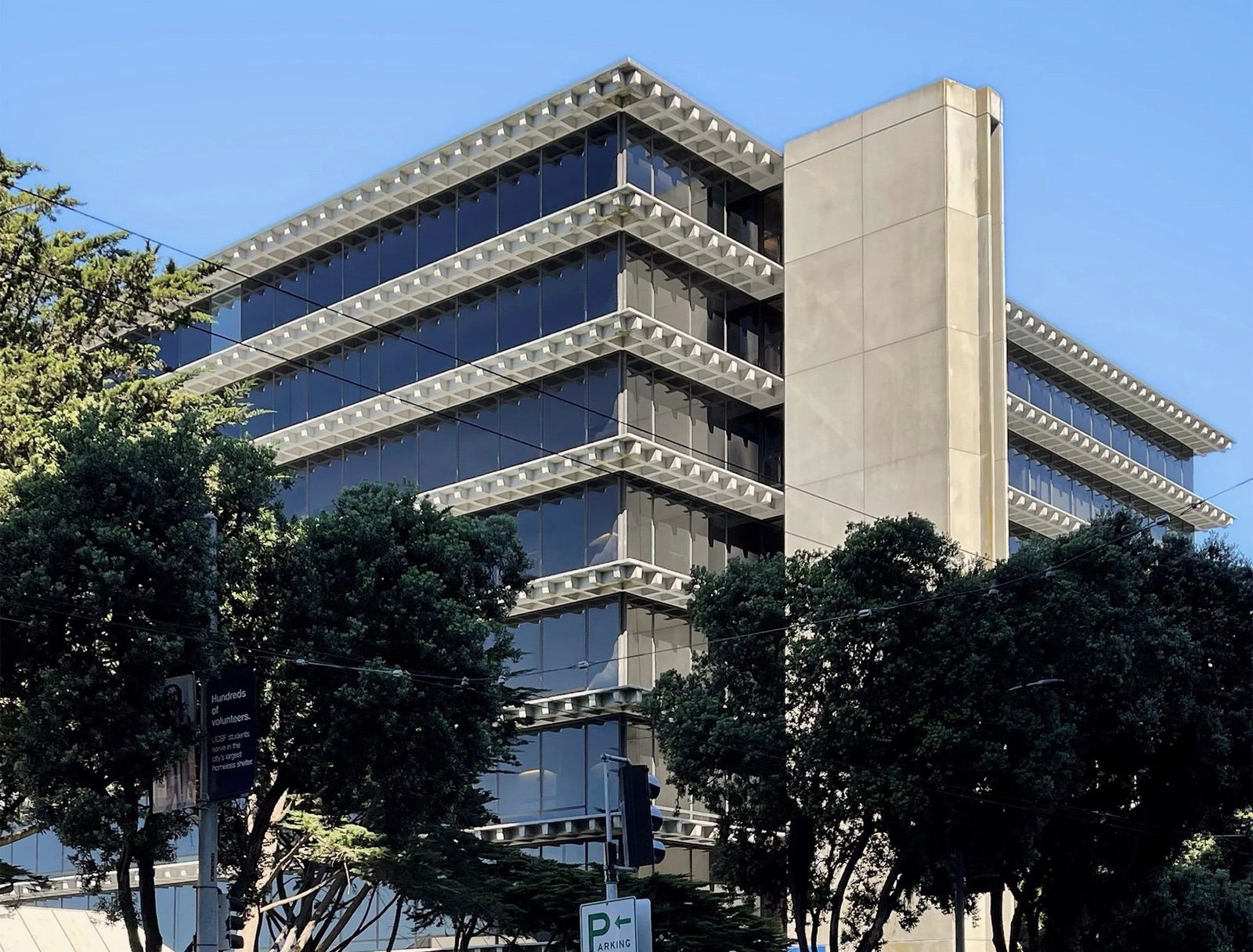
Client · University of California, San Francisco (UCSF)
Challenge: conservative assumptions, real constraints, a $1 billion price tag
Conventional seismic evaluation methods necessarily rely on conservative assumptions and simplifications made by structural engineers to ensure safety under real-world constraints — the analysis tools available in standard practice, the time and schedule available, the data on hand for modeling, and the computing power to run it. That conservatism exists for good reason. But it also means some buildings get flagged for retrofits they may not actually need, or for more extensive work than the underlying risk justifies, leading owners to spend capital where the real risk is lower than the analysis suggests.
That's what UCSF was facing: its Ambulatory Care Center (ACC) was evaluated under the University of California's seismic rating system and came back with a Tier 3 result that put the building on a path toward a mandatory retrofit estimated at $1 billion. UCSF wanted to know whether a more detailed and rigorous modeling approach might tell a different story before committing to that scale of construction.
Approach: a higher-fidelity seismic assessment, held to a high bar
HBRG partnered with SGH (Simpson Gumpertz & Heger) to apply a higher-fidelity assessment approach — a more detailed, rigorous, and research-backed analysis, which removes many of the conservatisms of the traditional ASCE 41 Tier 3 analysis common in practice. This included both what HBRG calls "Tier 3+" analysis (which fully complies with ASCE 41 but uses the best-available research modeling to provide less conservatism), as well as full collapse probability analysis using the FEMA P-695 analysis process. Both of these advanced approaches validated that the building had sufficient seismic safety and did not warrant retrofit.
Because unprecedented, state-of-the-art analysis techniques were used, the work was held to an unusually high bar: it was fully peer-reviewed by UCSF's full Seismic Review Committee and approved by the UCSF building department before any conclusion was accepted.
Result: no retrofit needed — $1B saved
The higher-fidelity analysis showed that the ACC's actual collapse risk did not warrant the retrofit that the original Tier 3 result implied. UCSF and UC accepted the findings, and the $1B was saved (which also frees up that capital to be deployed on retrofitting buildings that are actual collapse risks).
Learn more
Want the technical details behind this work? The "important campus building" in the webinar below is this very building — the UCSF Ambulatory Care Center. The HBRG team walks through the detailed Tier 3+ building-specific collapse risk assessment described in this spotlight, step by step.
Webinar 1: Detailed Tier 3+ Building-Specific Collapse Risk Assessment for an Important Campus Building
The assessment was also presented in two parts at the 2025 SEAOC Convention in San Diego:
More recorded sessions from this series are available on our Webinars & Training page.