
Just provide your Tier 1 screening report, and SP3-AI intelligently creates a model in SP3-RiskModel and provides quantified risk metrics backed by research: collapse probabilities, repair costs, and reoccupancy and functional recovery times.
- Quantified collapse probabilities — at every hazard level, DE and MCER, from your Tier 1 deficiencies
- Repair costs — expected loss (SEL and SUL) as a percent of building value, FEMA P-58 methodology
- Reoccupancy & functional recovery times — re-occupancy, functional recovery, and full recovery (ATC-138)
When doing an ASCE 41 Tier 1 deficiency-based evaluation, have you ever found yourself wishing it gave more risk information than just pass/fail for the checklist? Have you ever wished your Tier 1 analysis could give actual quantified collapse risk (i.e., collapse probability), or even repair costs and functional recovery times?
The new SP3-AI-ReportReader makes all of this possible — and automated.
SP3-AI-ReportReader is a new SP3-AI module — a software add-on for existing SP3-RiskModel licenses — that reads your ASCE 41 Tier 1 screening report and converts it into a detailed, building-specific seismic risk assessment in SP3-RiskModel.
How it works
SP3-AI intelligently converts your Tier 1 report results into detailed building inputs for SP3-RiskModel and the underlying SP3-CollapseRiskPredictionEngine, then runs a detailed building-specific seismic risk assessment using these SP3 analytical engines, which are backed by best available research (including full nonlinear structural response estimation using the SP3-StructuralResponsePredictionEngine).
The SP3-AI is responsible for automating the inputs, and the human intelligence encoded into SP3-RiskModel does the analysis — there is no AI in the analysis step, just best available research and science. As with every SP3-AI module, the structural engineer stays in full control and can review and confirm every analysis input before the analysis is run. The engineer can also run fully automated and review the inputs later, when convenient.
This process keeps the structural engineer in full control by clearly showing which SP3 input fields were populated by SP3-AI and prompting the engineer to review and approve them:
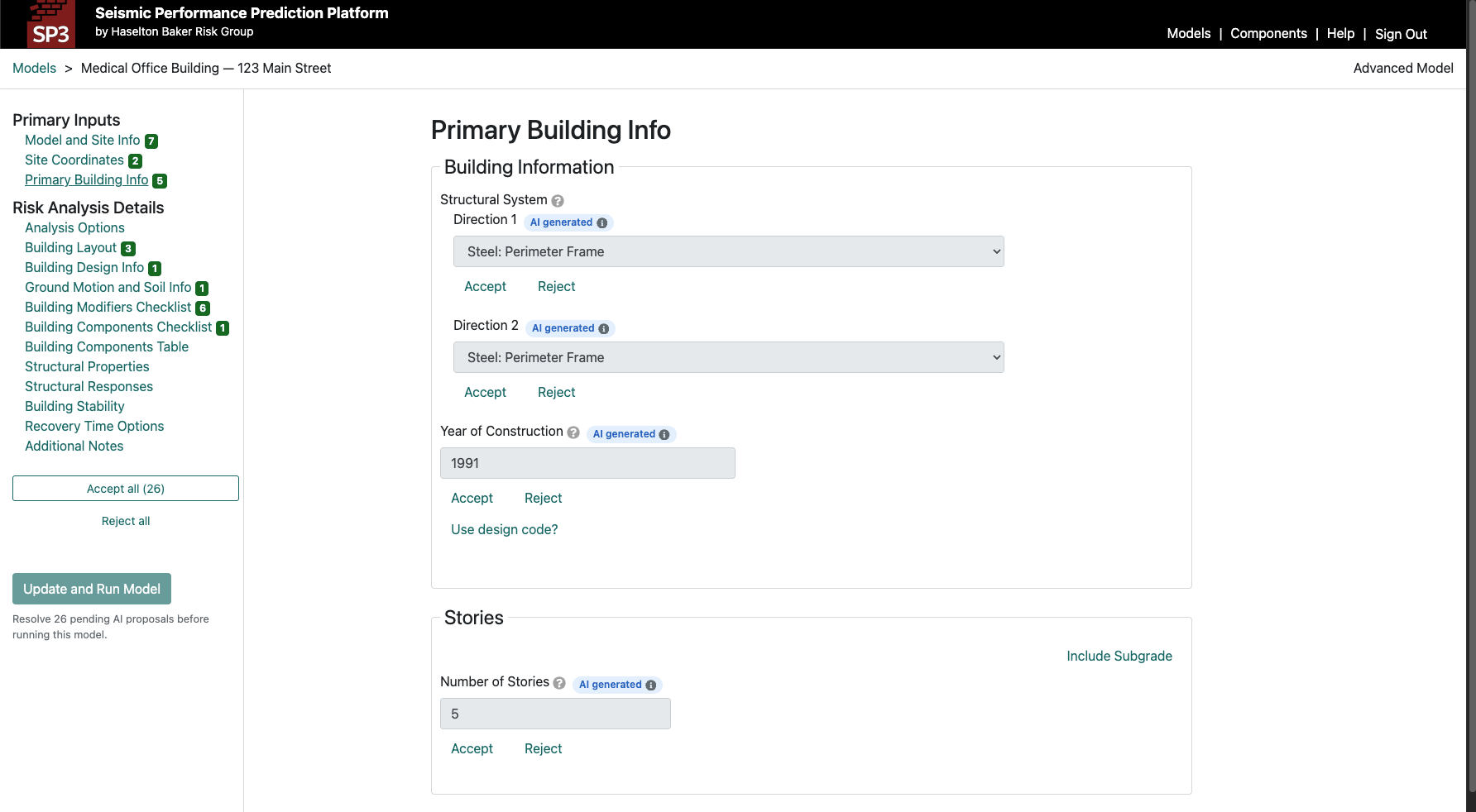
Every field populated by SP3-AI is tagged "AI generated" — accept or reject each one, or accept all, before the model runs.
What you get
At the end of the day, SP3-AI-ReportReader uses your Tier 1 report to create the rich, quantified seismic risk information you're accustomed to seeing from SP3-RiskModel. The example below was generated from a Tier 1 report:
Collapse and red tagging probabilities:
| Intensity | Return Period | P[red tag] | P[collapse] | P[excessive residual] |
|---|---|---|---|---|
| 90% in 50 years | 22 years | 0.10 | 0.08 | 0.0% |
| 50% in 30 years | 43 years | 0.17 | 0.14 | 0.0% |
| 50% in 50 years | 72 years | 0.24 | 0.21 | 0.0% |
| 50% in 75 years | 108 years | 0.31 | 0.28 | 0.0% |
| 50% in 100 years | 144 years | 0.36 | 0.34 | 0.0% |
| 20% in 50 years | 224 years | 0.45 | 0.45 | 0.0% |
| 10% in 50 years | 475 years | 0.61 | 0.67 | 4.6% |
| DE | 946 years | 0.79 | 0.93 | 36% |
| 5% in 50 years | 975 years | 0.79 | 0.94 | 37% |
| 2% in 50 years | 2475 years | 1.07 | 1.36 | 60% |
| MCER | 2650 years | 1.09 | 1.39 | 59% |
Expected Losses (SEL) and 90th Percentile Losses (SUL):
| Shaking Intensity | Return Period | SEL (%) | SUL (%) |
|---|---|---|---|
| 90% in 50 years | 22 years | 0.1 | 0.2 |
| 50% in 30 years | 43 years | 0.7 | 1.9 |
| 50% in 50 years | 72 years | 1.7 | 4.4 |
| 50% in 75 years | 108 years | 3.2 | 7.8 |
| 50% in 100 years | 144 years | 4.5 | 10 |
| 20% in 50 years | 224 years | 7.2 | 15 |
| 10% in 50 years | 475 years | 18 | 30 |
| DE | 946 years | 52 | 84 |
| 5% in 50 years | 975 years | 53 | 86 |
| 2% in 50 years | 2475 years | 86 | 100 |
| MCER | 2650 years | 86 | 100 |
Expected Recovery Times from the New FEMA P-58 Functional Recovery Module (ATC-138):
| Intensity | Re-Occupancy | Functional Recovery | Full Repair |
|---|---|---|---|
| 90% in 50 years | 0 days | 0 days | 5 days |
| 50% in 30 years | 0 days | 5.2 weeks | 3.2 months |
| 50% in 50 years | 0 days | 5.5 months | 5.6 months |
| 50% in 75 years | 2.2 months | 6.6 months | 6.6 months |
| 50% in 100 years | 3.5 months | 7.1 months | 7.2 months |
| 20% in 50 years | 4.9 months | 7.9 months | 7.9 months |
| 10% in 50 years | 8.1 months | 11 months | 11 months |
| DE | 14 months | 18 months | 18 months |
| 5% in 50 years | 14 months | 18 months | 18 months |
| 2% in 50 years | 34 months | 34 months | 34 months |
| MCER | 34 months | 34 months | 34 months |
What's next
SP3-AI-ReportReader is currently trained to do all of the above from typical ASCE 41 Tier 1 assessment reports, and will soon be trained to do the same from most other report types — BORP building background reports, PML reports (where structural information and deficiencies are properly documented), and more.
Use it on your next Tier 1 project
SP3-AI-ReportReader is available now as an add-on to your SP3-RiskModel license.
Questions? Contact support@hbrisk.com or +1 (530) 531-0295.
Also from SP3-AI
Previously released: SP3-AI-ResilientDesigner
Optimized resilient design, in a fraction of the time. Create an initial model in SP3-RiskModel, then our team runs SP3-AI to compare hundreds of design variants and deliver optimized, efficient resilient design options.